Where Will You Bloom?
Where is the soil from which your soul was fashioned?

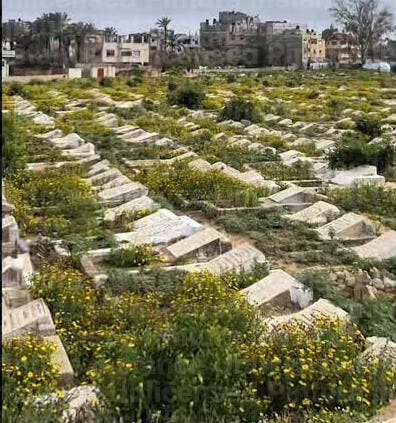
I saw a photograph of what is presumably a Palestinian martyr whose body had been entombed beneath reinforced concrete, as the occupation poured cement over him, burying him inside a solid block. (It could, of course, be an AI image but it is not without the realm of possibility that this crime has been done: the occupation has done much, much worse and has buried countless people alive.) In the image I saw, however, only his shoe remained visible beneath the hardened slab—a haunting testament to the savagery of his killers.
The image wounded me deeply. And in that moment, I realized something I had never truly reflected upon before:
How tender the earth is when we are even afforded it as our final burial place.
Why did Allah ordain that the human being be buried in earth after death?
Because all things, by their very nature, long for their origin. This body was created from dust, and when it returns to dust, it returns gently, lovingly, to the substance from which it was first fashioned. Paradoxically, burial restores the body to its primary element, returning it to perfect harmony. This, too, is among the Creator’s tenderness and mercy: He has given every created thing an origin from which it comes and to which it returns.
What a blessing it is that we are all bound for a return home!
This is why the sight of burned bodies, or bodies cast into rivers, pains me especially deeply. Even in death, they are deprived of that final reunion, that blissful harmony of the clay body with the earth’s clay .
Whenever I contemplate the natural world, I am continually astonished by the beauty and precision of Allah’s design. He placed the clouds in the heavens, yet when they bear water they descend again to the earth as rain. This is the only way they can return to the earth—through water—for water alone is the element suited to unite with the soil. Otherwise, the clouds belong only to the heavens.
Indeed, Allah is capable of transforming all things, causing them to pass through different states so that they may find their proper place within creation. A rose cannot bloom in the desert; the desert’s sands cannot sustain its stem or nourish its seed. The same is true of countless other trees and plants. Every landscape has its own vegetation: mountain flora, desert flora, meadow flora. So too with animals, each fashioned for its own habitat.
If this is true of plants and creatures who grow and live without having the faculty of reason, how much more true must it be of the human being, who has been divinely endowed with intellect?
Harmony is an essential condition for human flourishing. A person blossoms and becomes fruitful only where there is inward congruence. When someone finds themselves in an environment that does not resemble them, or among people who do not share their deepest values, the trial can be immense. Such circumstances may obstruct one’s outward development, though they need not prevent one’s inward growth.
I am reminded here of the companion Salman al-Farisi, who was born into a Zoroastrian family. One day he fled to a church. Later he escaped with a caravan to Syria, and eventually entrusted himself to another caravan bound for Medina after a monk told him that the final Prophet would soon appear there. When he met the final messenger Muhammad ﷺ—peace and blessings be upon him—he became one of his trusted companions and was granted an honor bestowed upon no other Companion, when the Prophet declared:
“Salman is one of us—the People of the Household (the Aal al Bayt).”
I recall this scene because Salman was not truly Salman when he was in the environment into which he had been born.
He only became fully himself in the presence of the Messenger of God, peace and blessings be upon him. There, he blossomed into his full potential, and grew into a beautiful, actualized bloom.
Every person must similarly search for their true inward belonging.
Your outward identity—your nationality, homeland, and family—is already determined.
But who are you, truly? Where is the soil from which your soul was fashioned? Where do you find your deepest harmony? Where is that earth in which, even if they were to bury you, you would still bloom?
These are questions that deserve profound contemplation. For only by wrestling with them can you come to know your truest identity with certainty.
And finally, may Allah’s blessings and peace be upon our beloved Muhammad—the light of the highest perfections, the spirit of sacred breezes, the inspirer of souls intimate with God—and upon his family and companions.
What a profound reflection. I had never really thought about origins and ends in this way before. And yet I am still hesitant to touch the soil with my bare hands even though even Western medicine is slowly recognizing the importance of “grounding.” Thank you for sharing your wisdom with us! May Allah swt bless you for your strength and patience in this troubled world.
Thank you for your insights, they bring light to the ones that read them and opens the minds that hear them.